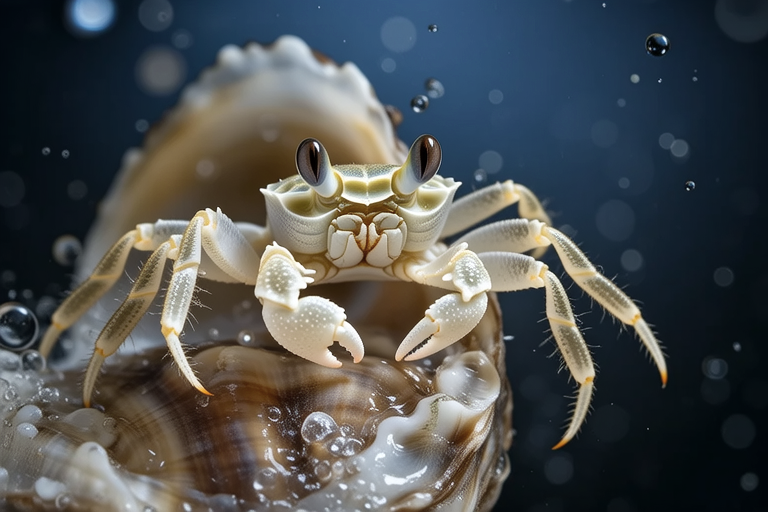
Tiny but Tenacious: How Pea Crabs Survive in Host Mollusks
In the vast ocean, where countless species coexist, there exists a remarkable partnership between pea crabs and their mollusk hosts. These tiny crustaceans, despite their diminutive size, have developed an intricate symbiotic relationship that ensures their survival in an otherwise challenging environment. This article delves into the fascinating world of pea crabs, exploring their anatomy, the challenges they face, and the unique survival strategies that make them tenacious survivors.
The Symbiotic Relationship
Pea crabs belong to the family Pinnotheridae and are known for their intimate association with various molluscan hosts, including scallops, oysters, mussels, and clams. This symbiosis is a classic example of mutualism, where both parties benefit from the relationship. The mollusk provides shelter, protection, and a reliable food source, while the pea crab, in turn, offers some degree of cleaning service by consuming parasites and detritus within the host’s mantle cavity.
For the mollusk, the presence of pea crabs can be advantageous as they help maintain the cleanliness of the host’s habitat. By feeding on debris and potential pathogens, these tiny crabs indirectly contribute to the health of their host. Additionally, the constant movement of pea crabs within the host’s body may aid in circulation and waste removal, further enhancing the mollusk’s well-being.
Anatomy Adapted for Living Inside Shells
The anatomy of pea crabs has evolved specifically to suit their life within the confines of their host’s shell. Their flattened bodies, typically measuring less than an inch in length, allow them to navigate the narrow spaces inside the host’s mantle cavity without causing significant discomfort. The carapace, or the upper shell, of pea crabs is soft and pliable, enabling them to squeeze through small openings and adjust to the varying sizes of their hosts.
Pea crabs possess specialized appendages that enhance their mobility and feeding capabilities within the host. Their antennae are highly sensitive, helping them detect changes in their environment and locate food sources. The mouthparts, or maxillipeds, are adapted for filtering fine particles from the water, ensuring that the crabs can efficiently gather nutrients from the surrounding fluids. Additionally, their legs are short and robust, facilitating movement and anchoring within the host’s cavity.
Challenges and Overcoming Them
Living within the tight confines of a mollusk’s shell presents numerous challenges for pea crabs. Space limitations require them to adapt their behavior and physiology to thrive in such an environment. One of the primary challenges is finding sufficient food within the limited space. Pea crabs have overcome this obstacle by developing efficient feeding mechanisms that allow them to filter minute particles from the water flowing through the host’s mantle cavity.
Another challenge is maintaining physical contact with the host to ensure a steady supply of oxygenated water. To address this, pea crabs have evolved behaviors that involve positioning themselves strategically within the host’s body. They often cling to the inner surface of the shell or attach themselves to the gills, ensuring continuous access to the water currents necessary for respiration.
Despite the close quarters, pea crabs manage to avoid being crushed by the host’s movements. Their flexible bodies and ability to flatten themselves against the shell interior prevent them from becoming trapped or injured during the host’s natural activities, such as opening and closing its valves.
Mating Habits Within the Host Environment
The reproductive cycle of pea crabs is closely tied to their host environment. Mating typically occurs within the safety of the host’s shell, minimizing the risk of predation. During courtship, male pea crabs release pheromones to attract females. Once a suitable mate is found, the pair engages in a brief mating ritual before the female deposits her eggs onto the underside of the host’s shell or within a specially prepared chamber.
The eggs are then guarded by the female until they hatch, ensuring the safety of the offspring. After hatching, the larvae are released into the surrounding water, where they drift with the currents until they find a suitable host to continue their lifecycle. This strategy increases the chances of successful reproduction and colonization of new hosts.
Unique Survival Strategies
Pea crabs have developed several unique survival strategies to cope with their challenging living conditions. One notable adaptation is their ability to regenerate lost limbs. If a leg or antenna is damaged or lost, pea crabs can regrow it over time, allowing them to maintain their mobility and sensory capabilities.
Additionally, pea crabs have been observed engaging in a behavior known as “host switching.” When a host becomes too crowded or unhealthy, pea crabs may leave the current host and seek out a new one. This behavior ensures that they always inhabit a healthy environment conducive to their survival.
Another intriguing aspect of pea crab behavior is their ability to influence the growth patterns of their hosts. Studies have shown that the presence of pea crabs can alter the rate at which a host grows, potentially leading to larger and more robust shells. This mutualistic effect underscores the complex interplay between the two species and highlights the significance of their symbiotic relationship.
Conclusion
Tiny but tenacious, pea crabs have mastered the art of survival within the confines of their mollusk hosts. Through their specialized anatomy, adaptive behaviors, and unique survival strategies, these crustaceans have thrived in environments that would be inhospitable to many other organisms. Their symbiotic relationship with their hosts exemplifies the intricate web of interactions that characterize marine ecosystems. Understanding the lives of pea crabs not only enriches our knowledge of marine biology but also underscores the importance of preserving these delicate relationships for the health and balance of our oceans.
