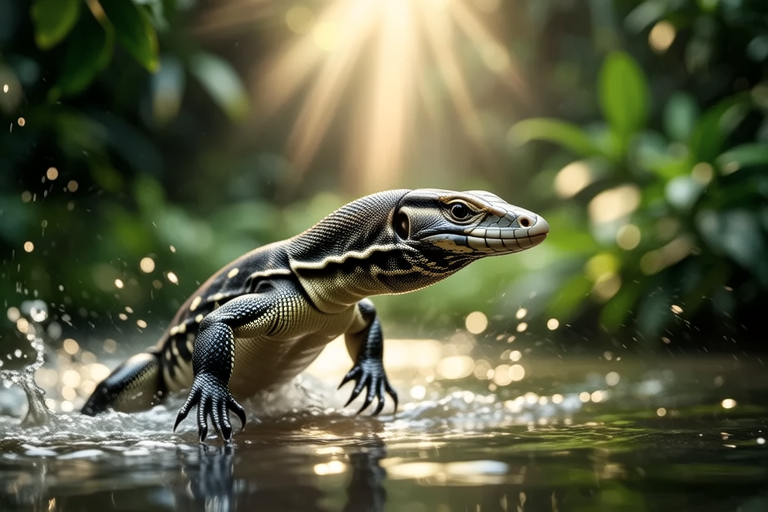
Unleashing the Water Monitor: Nature’s Aquatic Master
In the realm of reptiles, few creatures command as much respect and fascination as the water monitor (Varanus salvator). This formidable lizard stands out as one of nature’s premier aquatic reptiles, boasting a remarkable array of adaptations that enable it to thrive both on land and in water. Found across vast swathes of Southeast Asia, the water monitor is a testament to evolutionary prowess, embodying the perfect blend of power, agility, and adaptability.
The Unique Status of the Water Monitor
The water monitor is a member of the Varanidae family, which includes some of the largest lizards on Earth. Among these giants, the water monitor holds a special place due to its exceptional aquatic capabilities. Unlike many other reptiles, the water monitor is equally at home in the water as it is on land, making it a true aquatic master. Its ability to navigate both environments seamlessly is a result of millions of years of evolution, honed by natural selection to ensure survival in diverse ecosystems.
Physical Adaptations for Aquatic Life
One glance at the water monitor reveals its physical adaptations for an aquatic lifestyle. Its elongated, streamlined body is designed for efficient movement through water, reducing drag and allowing it to swim swiftly. The tail, which accounts for about half of the lizard’s total length, serves as a powerful propulsion mechanism, enabling the water monitor to maneuver with grace and precision. The tail’s muscular structure allows for rapid acceleration and precise steering, crucial for catching prey or escaping predators.
Additional physical features include webbed feet, which enhance its swimming abilities, and nostrils positioned high on the snout, ensuring they remain above water even when the lizard is partially submerged. These adaptations, combined with strong limbs and sharp claws, make the water monitor a formidable predator both on land and in water.
Behavior: Feeding Habits and Hunting Techniques
The water monitor is an opportunistic feeder, with a diet that includes a wide variety of animals, from insects and fish to small mammals and birds. Its hunting techniques are as varied as its diet, showcasing the lizard’s intelligence and adaptability. On land, it uses stealth and speed to ambush prey, often hiding in dense vegetation until an unsuspecting animal comes within striking distance. Once prey is detected, the water monitor lunges forward with incredible speed, using its powerful jaws to deliver a swift, deadly bite.
In water, the water monitor employs a different set of tactics. It can dive deep and stay submerged for extended periods, thanks to its efficient respiratory system. Using its keen eyesight and sense of smell, it locates fish, amphibians, and crustaceans. The water monitor is also known to scavenge, consuming carrion when available. This versatility in feeding strategies ensures that the water monitor can survive in a wide range of habitats, from dense jungles to open grasslands.
Interactions Within Its Ecosystem
The water monitor plays a vital role in its ecosystem, serving as both predator and prey. As a top predator, it helps control populations of smaller animals, contributing to the balance of local food webs. However, it is also vulnerable to predation by larger carnivores, including crocodiles and big cats. These interactions highlight the intricate web of relationships within the ecosystem, where every species plays a part in maintaining ecological stability.
Water monitors are also known to be quite social, sometimes gathering in groups, especially during breeding season. Males engage in combat, using their tails and powerful bites to establish dominance. Females, after mating, lay clutches of up to 40 eggs in termite mounds or burrows, providing a natural incubation environment. The hatchlings emerge fully formed, ready to fend for themselves in their challenging environment.
Habitat Range Across Southeast Asia
The water monitor is native to Southeast Asia, ranging from India to Indonesia and extending into parts of China. Its habitat includes rainforests, mangroves, swamps, and riverbanks, areas rich in biodiversity and conducive to its dual-life existence. The water monitor thrives in environments where water bodies are plentiful, providing ample opportunities for hunting and basking. Despite its wide distribution, the water monitor faces several threats, particularly from human activities such as deforestation, pollution, and overhunting.
Conservation Challenges
The water monitor faces numerous conservation challenges, primarily stemming from human activities. Deforestation and urbanization have led to the destruction of its natural habitats, forcing the lizards to seek refuge in increasingly fragmented and degraded landscapes. Pollution of water bodies, often caused by agricultural runoff and industrial waste, poses additional threats to the water monitor’s health and survival. Overhunting, driven by demand for meat and skin, has also taken a toll on water monitor populations.
Efforts to conserve the water monitor include establishing protected areas, promoting sustainable land-use practices, and raising awareness among local communities about the importance of preserving this iconic species. Conservationists are working tirelessly to ensure that future generations will continue to marvel at the water monitor’s extraordinary abilities.
A Remarkable Example of Evolutionary Adaptation
The water monitor is a remarkable example of evolutionary adaptation, demonstrating how natural selection shapes organisms to thrive in specific environments. Its unique combination of physical traits and behaviors allows it to exploit both terrestrial and aquatic resources, making it an adaptable and resilient species. The water monitor’s success in navigating diverse habitats underscores the importance of biodiversity and the interconnectedness of ecosystems.
As we continue to explore the natural world, the water monitor serves as a reminder of the wonders that await us. By understanding and protecting these remarkable creatures, we not only safeguard their future but also contribute to the preservation of our planet’s rich tapestry of life.
